



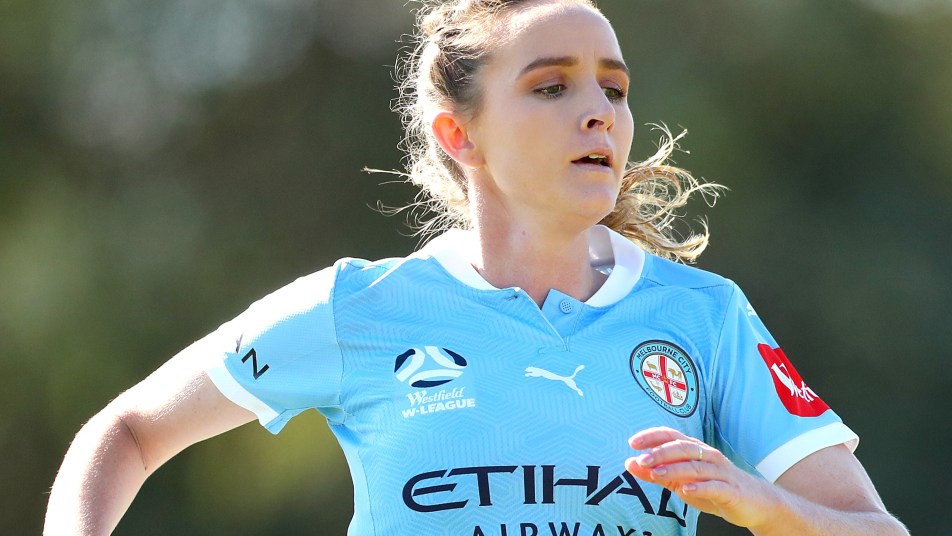
As she joins KEEPUP as a columnist, the ex-Melbourne City title winner tells Tom Smithies about life after retirement, her partner’s recovery – and having strong views in football.
It’s been 20 months since Rhali Dobson’s retirement went viral, but it took a recent drive through Newcastle to bring home the finality of her football career.
With hardly any chance to think in the time since her partner Matt proposed at the end of her final game (a moment caught on camera, and all the more emotional as she was retiring to support Matt in his treatment for cancer) Dobson was suddenly reminded of preseasons past, and the fact there won’t be another.
She does, it’s important to note, have much else that’s good going on in her life – days filled with work as an occupational therapist, playing NPL in Northern NSW and planning for a wedding to Matt next month that follows him responding well to treatment for his brain cancer.
“But yeah, it’s probably sinking in more this year than what it did last year that professional football is over,” she says. “Because I was so distracted with Matt’s treatment and getting him through all that and the recovery. So even now, I find I’m going to the gym in the afternoon, and then I’m driving past the place where I used to do a lot of my preseason running.
“And I’m like, Oh, I should just go do this running and then I think, Oh, I don’t have to anymore. So why would I put myself through that torture? It’s kind of bittersweet knowing I can still be at that level and still be playing but knowing that there’s a bigger picture as to why I put in my retirement.
“It wasn’t even a hard decision to make in the end. As soon as we got the news. I made the decision on the spot because life is bigger than football. So for me, I know I can always be involved in some way. It just means that I’m not away from him for significant times during the year.”
The wedding will give a chance for a number of former teammates of Dobson to celebrate Matt’s progress, including the likes of Melissa Barbieri, Alex Chidiac and – flying in from Sweden – Avi Luik.
There’s coaching too, working one on one with some young players in her orbit, but Dobson wants to make a contribution in another way to developing f ootball, in a way she feels strongly is currently under-serviced.
From next week the two-time A-League Women title winner will write a weekly column for KEEPUP, keen to explore issues that sometimes get left unsaid – to critique where necessary, as well as use her experiences to take readers inside the professional game.
“For me, seeing what it’s like around the rest of the world, not just for females but for men too, and being able to have an intellectual and honest conversation, that’s missing from our sport here,” she says.
“I feel very strongly that we need to make sure that punditry and commentary is not just all, you know, rainbows and unicorns. That’s what’s very much missing from the female game. We don’t like to point out the need for improvement or be asking the big questions and being critical. It’s almost not allowed in female football, particularly in Australia.
“I feel it’s something that’s missing in the Matildas’ development as a national team. We love the Matildas, who doesn’t, and I support them moving forward into this World Cup and building towards that.

“But there are still questions that are being shut down or not being allowed to be asked. And I feel that they could only benefit from that, knowing what the rest of the football world is seeing and whether they can learn from that.
“When you’re in camp, and when you’re in that environment, you’re only seeing one side of the story, regardless of who’s involved.”
Dobson’s point is that criticism doesn’t have to be seen as personal, and that honest exchanges of views can be beneficial -using an admittedly extreme example to make the point.
“One time I got subbed off, the only time I got subbed off at halftime in the W-League; I saw my coach the next day, and I said, I don’t understand why this happened, people were saying I was playing really well. And his response was, Are you f****** kidding me? You were shit.
“For me, I had a lot of respect for that because you’re my coach. The outside voices were my family and friends but I needed to hear that (from the coach) because frankness really helps players go okay, let me actually go and review my game and actually have a good think about this.

“When you’re in those national setups, you get very much spoonfed a lot of information and it gets to the point where that’s what you believe, and you don’t really look back at your games critically enough yourself.
“You need that critical side of things to really develop not just as a player but as a person and be able to take on that criticism, whether it’s in the public eye or privately.”